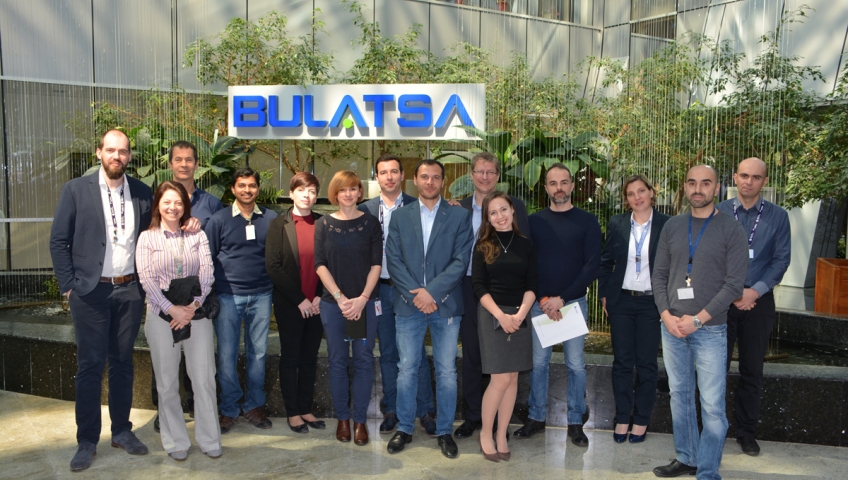

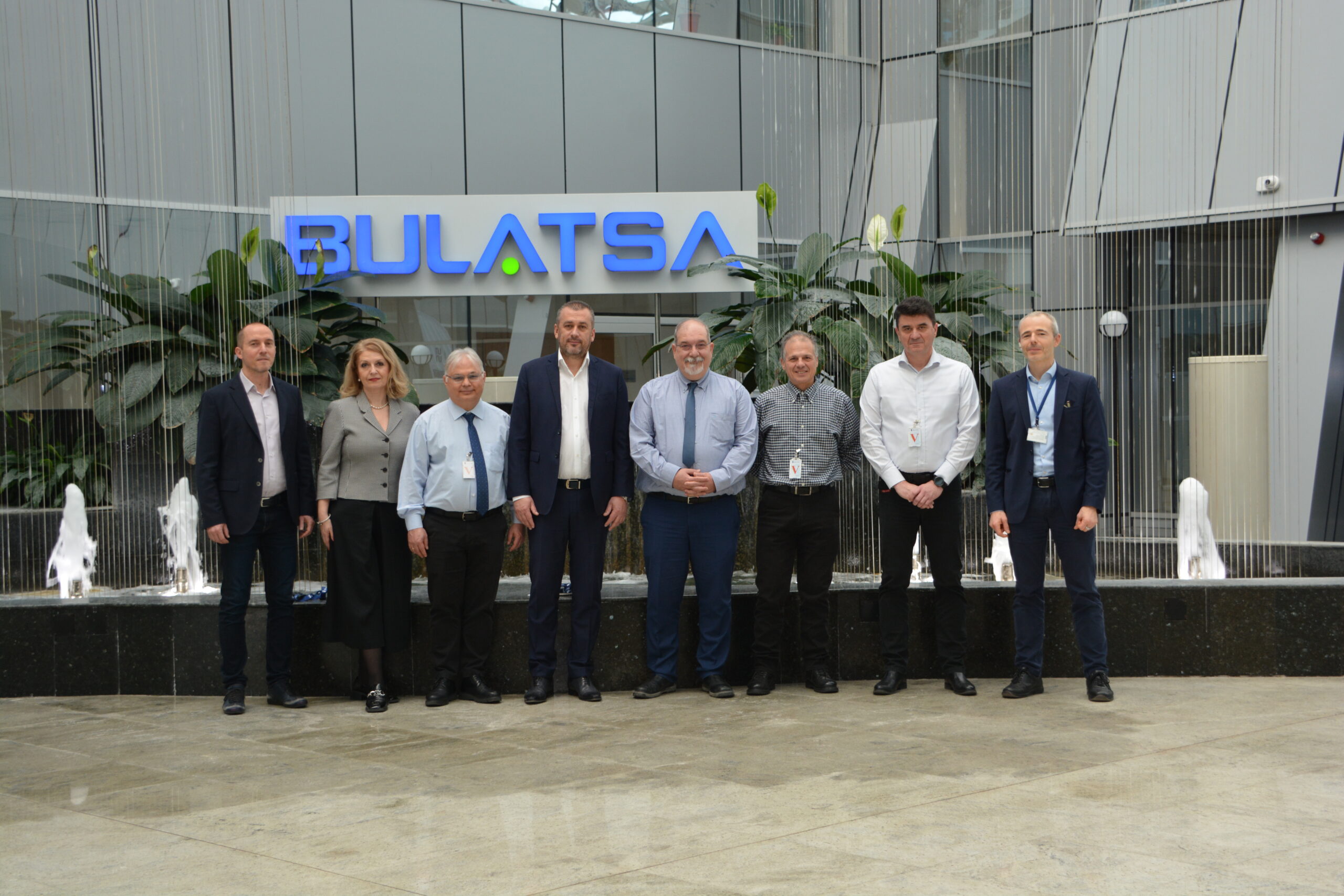
Representatives of Lufthansa airline visited BULATSA and got acquainted with the activities of the company. They had the opportunity to be informed about the overall activity, the specifics of the operations of Air Traffic Controllers and the different stages of their training.
At the meeting were discussed the challenges airlines are facing for capacity management and the quality, flexible and efficient service provided by BULATSA in the context of ever-increasing traffic.
Big interest arose the visit to the Training Center and the operational room at Sofia Air Traffic Control Center, where they monitored in real time the training process at the modern air traffic control simulator of BULATSA and the servicing of the air traffic over Bulgaria.
As of April 6, started the normal operations at the new Istanbul airport. On this date entered into force the new Letters of Agreement between BULATSA and the Turkish air navigation services provider DHMI. According to the agreed procedures, Bulgarian air traffic controllers interact and coordinate with their colleagues from Turkey a main part of the traffic to and from the new airport, as well as the currently expanding Sabiha Gokcen Airport on the Asian coast of Istanbul. Also in operation is the new Cross-border Arrival Management tool XMAN, part of DHMI’s Arrival Manager AMAN. The system serves to arrange the arriving traffic and reduce aircraft delays when approaching the airport as early as from the Bulgarian territory.
Although only a few days have passed since the start of operation of the new airport, the first results show that the serious preliminary training of the Bulgarian air traffic controllers has been conducted with high quality and in accordance with the highest standards in aviation.
The developed in BULATSA training programs, including theoretical training and practical exercises, provided the necessary preparation for optimal response to the changes in the airspace organization and the working procedures accompanying the opening of the new airport. Significant progress has been achieved in integrating the traffic from and to Istanbul into the intense traffic in the airspace serviced by BULATSA.
BULATSA will continue to perform professionally the activities agreed so far with the Turkish side, which will bring significant benefits to aviation operators and passengers, such as reducing the holding time on approach and reducing fuel consumption, which in turn will lead to increased flight efficiency and reduced environmental impact.
BULATSA hosted a Visitors’ Day to present the conducted validation of the TESLA prototype for pre-industrialization phase, under project PJ.10-02a – “Improved Performance in the Provision of Separation”. The prototype TESLA (Tactical Encounter SoLver Assistant) is a joint project of Airbus D&S and BULATSA, launched in 2016 in fulfillment of activities of SESAR 2020 Programme. Representatives of the air navigation service providers of France, Germany, Poland and Italy and other guests from the industry, including Airbus Aircraft and Deep Blue Consulting & Research, got acquainted with the prototype’s progress and functionalities in interactive format. They watched a demonstration session of TESLA’s behavior and capabilities through air traffic management simulation. Bulgarian air traffic controllers demonstrated the resolution of many conflict situations in the area of Sofia Approach and Sofia Control through the use of the prototype, which examines the possibilities for improving the accuracy of the predicted airplane trajectory using current flight data from the aircraft board (EPP – Extended projected profile). * SESAR 2020 is a programme of the European Union that is focused on the development and validation of technological solutions in the field of air traffic management. It is funded by the Horizon 2020 Research and Innovation Programme.
On 25 March 2019 started a validation of project PJ.10-2a “Improved Performance in the Provision of Separation”, Phase V3 (“pre-industrialization”), to demonstrate the maturity of the prototype TESLA (Tactical Encounter SoLver Assistant).
The prototype was developed by Airbus Defense and Space (Airbus D&S) in accordance with the operational requirements of BULATSA, in fulfillment of project PJ 10 activities of SESAR 2020 Programme. The purpose of the project is to provide Air Traffic Controllers (ATCOs) with automated means for detecting and preventing conflicts between aircraft, increasing the capacity of airspace and supporting the management of the increasing traffic. The validation is conducted in the test platform “BULATSA Innovation Grid”, specially equipped with workstations for ATCOs and pseudo-pilots.
The validation of TESLA functionalities is conducted through simulation of the air traffic management in the area of Sofia Approach and Sofia Control with significant complexity and traffic intensity. The possibilities for improving airplane separation accuracy by using actual flight data from the board of the aircraft – EPP (Extended Projected Profile) are also being examined.
The Bulgarian air traffic controllers will assess the possibilities for resolving multiple conflict situations with the use of the prototype. The validation exercise will gather information on the maturity of TESLA (according to SESAR Programme standards), which information will be subject to expert analysis. The results and the final assessment of the prototype capabilities are expected in the second half of 2019.
* SESAR 2020 is a programme of the European Union that is focused on the development and validation of technological solutions in the field of air traffic management. It is funded by the Horizon 2020 Research and Innovation Programme
During the World ATM Congress in Madrid air traffic controllers from BULATSA and engineers from AIRBUS Aircraft and AIRBUS Defence and Space participated in a three-day joint demonstration of the expanded and tested so far functionalities of the TESLA prototype for phase V2 (Feasibility) – part of SESAR 2020 Programme.
The prototype has been developed by BULATSA and AIRBUS Defence and Space under SESAR Solution PJ.10-02a – Tactical Encounter Solver Assistant (TESLA).
The TESLA prototype aims at assisting ATCOs in resolving potential conflicts in terminal areas with medium and high traffic density with the purpose of tactical separation control. The prototype shall assess the ATCO’s work and present different options for conflict prevention by analyzing aircraft trajectories and suggesting actions for resolution of each specific situation.
The teams carry out preparatory activities for validation of Phase V3 (pre-industrialization), which include conducting a real-time simulation using the prototype developed. The exercise is planned to be conducted in the end of March 2019 in BULATSA, Sofia.
A discussion hosted by FABEC on airspace capacity in Europe was held yesterday at the World Air Traffic Management Congress in Madrid. Representatives of functional airspace blocks in Europe (DANUBE FAB, BALTIC FAB, BLUE MED FAB, FABCE, FABEC) and the Network Manager discussed the views and experiences of passengers. The aim is to share the practices of the difficulties in servicing the increasing traffic and delays.
BULATSA’s position was presented by the Director of European Programmes, Projects and Strategies in BULATSA Mr. Veselin Stoyanov. Participants paid attention to factors, other than the provision of ANS, that have significant impact on airspace capacity. Analyzed was also the need to improve the environmental performance indicator, not only in the deviation from the shortest route, but also the possibility of using airspace and the preferences of airlines, for example an indicator that takes into account the free route compared to the other flight planning possibilities.
Earlier at the Congress was also held a debate on the participation of functional airspace blocks in SESAR solutions, hosted by DANUBE FAB and moderated by James Hanson, Helios. In the discussion took part Mr. Nikolas Warinsko (SDM), Mr. Filip Cornelis (DG MOVE), Mr. Jakob Kepa (SDM) and representatives of DANUBE FAB, BALTIC FAB, BLUE MED FAB, FAB Europe Central and FAB Central Europe.
A main focus was placed on the challenges and opportunities for developing the role of FABs. FAB representatives united in their desire to further develop the FAB concept and to ensure participation in the preparation of the future European airspace architecture. They expressed firm support for the development of the functional airspace blocks in the context of SESAR. According to Mr Nikolas Warinsko, SDM is ready to continue its work on FABs involvement as key factors in SESAR’s technological progress.
SESAR Deployment Manager (SDM) and SESAR Joint Undertaking (SJU) organized a congress walking tour at the World ATM Congress in Madrid. It gave visitors an opportunity to meet with experts from the SESAR community and to get acquainted with the activities that are being prepared and deployed in whole Europe.
The walking tours took place within the context of a sequence of activities, organized by European aviation partners on the theme “Europe for Aviation”. DANUBE FAB for a second consecutive year presented many of its key projects contributing to the transformation of Air Traffic Management (ATM).
BULATSA and ROMATSA experts showcased SESAR related projects, representing technological solutions in various areas of ATM deployment, such as optimizing the performance of air traffic System-Wide Information Management and Security.
The DANUBE FAB sequence of presentations in the SESAR Walking Tours started with an overview on the latest solutions related to the implementation of the Traffic Complexity Assessment Tool (tCAT) project in Sofia ACC. It was presented by Ivan Hassamski, who also informed about a tCAT Visitors’ Day planned to take place on 26 March 2019 at BULATSA premises in Sofia, Bulgaria.
The DANUBE FAB stand hosted three SESAR Walking Tours on the topics of System-Wide Information Management and Security.
Mihai Spiridonescu (ROMATSA) made a presentation focused on the stakeholder’s contribution to the procurement and deployment of NewPENS.
Florin Stoian (ROMATSA), supported by Patrick Mana (EUROCONTROL), showcased SWIM Common PKI and the policies and procedures for establishing a secure framework, which allows ANSPs, airspace users, military, airports, etc., to identify themselves and encrypt/decrypt information via digital certificates.
Daniela Vasileva (BULATSA) presented the successful implementation of a local Security Operation Center (SOC) at BULATSA within the framework of SESAR. The local SOC in BULATSA provides a platform for monitoring, analysis and control of system logs, network traffic, system files and management of incidents related to information security. The platform is a comprehensive solution providing reliable protection of BULATSA’s IT infrastructure against conventional and unconventional cyber-threats.
The Director General of BULATSA Mr. Georgi Peev participated in CANSO CEO Strategy Summit which took place on 11 March 2019, prior to the opening of the World ATM Congress (WATMC). The biggest international event for air traffic management, organized by CANSO in partnership with the Air Traffic Control Association (ATCA), was opened yesterday in Madrid and will continue until 14 March.
The Summit started the activities related to WATMC and is an event with the participation of high-level professionals which brings together CANSO Member CEOs to discuss the current development of the ATM industry and the CANSO strategy. This year a main topic of the discussions is “Cybersecurity in ATM”.
As part of WATMC 2019 Georgi Peev also participated in the CANSO Conference “Tackling the Big Issues in ATM – Capacity, UTM Integration, People”. At the forum were discussed the integration and management of drones, attracting and keeping the next generation of ATM professionals and exploring the best ways to provide the necessary growth in ATM capacity. Keynote speakers at the Conference were Mr. Henrik Hololei, Director-General for Mobility and Transport, the European Commission, and Mr. Daniel Elwell, Acting Administrator of the Federal Aviation Administration (FAA) of the USA.
The international partners of the aviation community marked also the 50th anniversary of the establishment of BULATSA.
The ski team of BULATSA ranked 10th in the 44th International Winter-Championship of Air Traffic Controllers, which was held in Sochi. More than 700 skiers from 49 teams from all over Europe, USA, Australia and Russia competed in the disciplines cross-country skiing, snowboarding and giant slalom skiing in Rosa Khutor resort.
25 Bulgarian air traffic controllers from BULATSA took part in all disciplines. Very good results were achieved by Svetlin Tzvetanov, who ranked 6th in his age group in the giant slalom, and Georgi Doganov – 10th in the ski running. The team also won the “Best Design T-shirt” cup, dedicated to Sanya Borzak (a Russian colleague who has passed away a few months ago).
BULATSA and LEONARDO hosted a Visitors’ Day to present the results of the validation on projects PJ.03a – Integrated Surface Management (SUMO) and PJ.03b – Airport Safety Nets (SAFE) of SESAR 2020 Programme, conducted on a test system GAINS.
The purpose of PJ.03а project is to find a solution for improved guidance of aircraft and motor vehicles on the airport surface combined with routing. PJ.03b gives a solution for enhanced airport safety nets, assisting air traffic controllers to avoid conflicts. BULATSA participates in these projects, together with LEONARDO, to share its views on the better definition of system functionalities and to support the validation of PJ.03a / PJ.03b, which took place in BULATSA between 22-26, October 2018.
Within the Visitors’ Day were conducted exercises on LEONARDO’s system GAINS and were tested two sets of software functionalities – Route Planning and Management (PJ.03a) and Surface Conflict Alert (SCA) Functionalities (PJ.03b). The event was also attended by international experts from AirFrance, UkSATSE (ANSP of Ukraine), Crocontrol (ANSP of Croatia), ROMATSA (ANSP of Romania), LFV (ANSP of Sweden), ENAV (ANSP of Italy) and representatives of the International Air Transport Association (IATA).
We use cookies in our website to give you the most relevant experience by remembering your preferences and repeat visits. By clicking “Accept”, you consent to the use of the cookies explicitly. Visit Cookie Settings to know more about the cookies used on our website.
This website uses cookies to improve your experience while you navigate through the website. Out of these cookies, the cookies that are categorized as necessary are stored on your browser as they are essential for the working of basic functionalities of the website. We also use third-party cookies that help us analyze and understand how you use this website. These cookies will be stored in your browser only with your consent. You also have the option to opt-out of these cookies. But opting out of some of these cookies may have an effect on your browsing experience.
These cookies are necessary for the website to function and cannot be switched off in our systems. They are usually only set in response to actions made by you which amount to a request for services, such as setting your privacy preferences, logging in or filling in forms. You can set your browser to block or alert you about these cookies, but some parts of the site will not then work. These cookies do not store any personally identifiable information.
Cookies used
Cookie
Duration
Description
cookielawinfo-checkbox-necessary
11 months
This cookie is set by GDPR Cookie Consent plugin. The cookies is used to store the user consent for the cookies in the category "Necessary".
cookielawinfo-checkbox-performance
1 year
This cookie is used to keep track of which cookies the user have approved for this site.
viewed_cookie_policy
11 months
The cookie is set by the GDPR Cookie Consent plugin and is used to store whether or not user has consented to the use of cookies. It does not store any personal data.
These cookies enable the website to provide enhanced functionality and personalisation. They may be set by us or by third party providers whose services we have added to our pages. If you do not allow these cookies then some or all of these services may not function properly.
Cookies used
Cookie
Duration
Description
pll_language
1 year
This cookie is set by Polylang plugin for WordPress powered websites. The cookie stores the language code of the last browsed page.
Analytical cookies are used to understand how visitors interact with the website. These cookies help provide information on metrics the number of visitors, bounce rate, traffic source, etc.
Coocies used
Cookie
Duration
Description
_ga
2 years
This cookie is installed by Google Analytics. The cookie is used to calculate visitor, session, campaign data and keep track of site usage for the site's analytics report. The cookies store information anonymously and assign a randomly generated number to identify unique visitors.
_gat_gtag_G_B6F5KKJXTX
1 minute
This cookie is installed by Google Analytics. The cookie is used to calculate visitor, session, campaign data and keep track of site usage for the site's analytics report. The cookies store information anonymously and assign a randomly generated number to identify unique visitors.
_gid
1 day
This cookie is installed by Google Analytics. The cookie is used to store information of how visitors use a website and helps in creating an analytics report of how the wbsite is doing. The data collected including the number visitors, the source where they have come from, and the pages viisted in an anonymous form.
Any cookies that may not be particularly necessary for the website to function and is used specifically to collect user personal data via analytics, ads, other embedded contents are termed as non-necessary cookies. It is mandatory to procure user consent prior to running these cookies on your website.
Cookies used
Cookie
Duration
Description
cookielawinfo-checkbox-non-necessary
11 months
This cookie is set by GDPR Cookie Consent plugin. The cookies is used to store the user consent for the cookies in the category "Non Necessary".